
Special Relativity
The Twin Paradox
The apparent asymmetry of relativistic motion and its resolution
This essay examines the twin paradox in detail, showing how two observers can each regard the other as moving while nevertheless measuring different elapsed times when they reunite. The apparent asymmetry is resolved directly from the Lorentz transformations and the different spacetime descriptions of the journey.
Prerequisites
- Linear algebra and inner-product spaces
- Multivariable calculus
- Fundamental principles of special relativity
- Lorentz transformations
Contents
- Twin paradox
- Time dilation
- Length contraction
- Relativity of simultaneity
- Lorentz transformations
- Proper time
Contents
I. Introduction
In this essay we will discuss the twin paradox, which arises in relativity when two objects, initially at the same position and each equipped with its own clock, move away from each other and later return to the same position. We assume that the two clocks are initially synchronized and therefore measure exactly the same time. When the two objects meet again, however, the clocks will in general have measured different elapsed times.
In the twin experiment, one of two identical twins embarks on a space journey, moving at a speed close to the speed of light, while the other remains at home and waits for the traveling twin to return. When the twins meet again, the twin who remained at home has aged more than the one who traveled. This result appears paradoxical in two different ways. First, it is very counterintuitive to accept that simply moving differently can change the amount of time experienced by the two twins. Second, and more importantly, there appears to be a breaking of symmetry. Why should one twin age differently from the other when there is no privileged system of reference? It seems as though the younger twin must somehow be different from the twin who remained at home. Yet, during their relative motion, each twin may regard the other as moving. We will examine in detail how this apparent asymmetry arises and why there is no contradiction with the principle of relativity.
Below we will make use of formulas derived in the essay Lorentz Transformations . In particular, we will need the transformation between two inertial reference frames and , where moves with velocity relative to . The Lorentz transformation for this boost is
Eq:Lorentz_transformation
Here,
Eq:Lorentz_factor
We will restrict our analysis to the case in which the relative velocity is directed along the -axis. In this case, the corresponding transformations of space and time are
Eq:Lorentz_transformation_along_x
As shown in the essay Composition of Velocities , the two frames measure relative velocities of equal magnitude and opposite direction:
Eq:Reciprocal_relative_velocities
These equations provide the kinematic relations needed to compare the elapsed times measured along the twins' different journeys.
II. Description of the Experiment
We will describe the experiment in terms of physical events . An event is a definite physical occurrence, such as the departure of the rocket or its arrival at planet . The event itself is independent of the reference frame, although different reference frames generally assign different space and time coordinates to it. Consequently, a distance, an elapsed time, or a statement of simultaneity is meaningful only after the events used in the comparison have been specified.
Let us consider the Earth as the origin of the spatial coordinates of a reference frame with coordinates , and let us consider a planet located at a distance along the -axis of this frame.
We assume that one of the twins remains at the origin of the Earth reference frame and is equipped with a clock that he uses to measure time . This twin does not change his position with respect to this reference frame and measures spatial distances using the Earth coordinate system.
We now consider the other twin, who will travel toward the planet . We assume that, at the beginning of the journey, the two twins occupy exactly the same position. At this instant, the twin on the rocket introduces a spatial coordinate system whose origin and axes coincide with those of the Earth frame. The time measured by the clock carried by this twin will be denoted by .
Before departure, the twins synchronize their clocks and denote the departure event by , choosing it to correspond to
At this instant their relative velocity is still zero, and the two spatial coordinate systems coincide. They therefore both agree that the planet is located at a distance from Earth along the positive -axis.
The twin on the rocket now begins his journey toward the planet , following a straight trajectory along the direction of the common -axis.
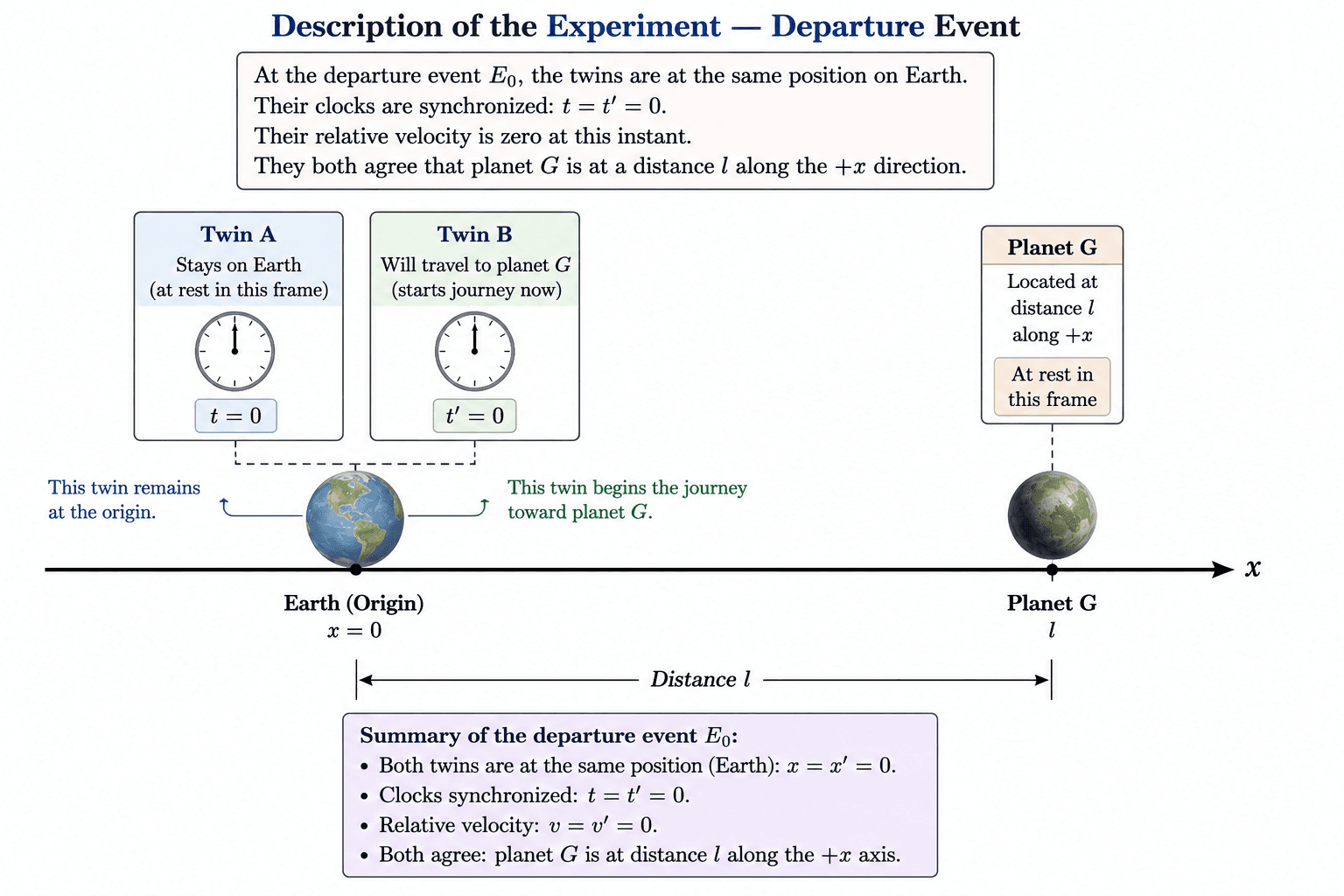
Departure event
1. Acceleration to
We now consider the initial portion of the journey during which the rocket accelerates until it reaches the cruise velocity We use the following two events to delimit this phase:
- •The rocket leaves Earth and begins its initial acceleration.
- •The rocket reaches the cruise velocity .
The twin on Earth assigns to event the coordinates
and to event the coordinates
where is the time required, according to the Earth clock, for the rocket to reach its cruise velocity, and is the corresponding position of the rocket relative to Earth.
The clock carried by the rocket is also set to zero at event . Let denote the elapsed time measured by this clock between events and . Since the rocket is accelerating during this interval, there is no single Lorentz transformation that relates the Earth frame to the rocket over the entire acceleration phase. Instead, at every instant we consider the Lorentz transformation whose velocity parameter is equal to the instantaneous velocity of the rocket.
For a Lorentz transformation with velocity parameter along the -axis, the differential of the time coordinate is
Eq:Lorentz_transformation_differential_time
Looking at the differential above, we may wonder why no term proportional to appears, since the velocity of the rocket is itself changing with time. The reason is that the velocity appearing in the Lorentz transformation is a parameter of the transformation. For each Lorentz transformation it is therefore held fixed when the differential with respect to the spacetime coordinates is taken. Thus,
contains no contribution proportional to .
During the acceleration phase, the value of the parameter changes along the trajectory of the rocket. We therefore use, at each event of the trajectory, the Lorentz transformation whose velocity parameter is equal to the velocity of the rocket at that event. In this sense, represents the infinitesimal time measured in the corresponding instantaneous rocket frame; it should not be interpreted as the differential of a single inertial time coordinate extending over the entire acceleration phase. Rather, we consider a family of Lorentz transformations
and at each instant we use the member of this family whose fixed parameter is equal to the instantaneous velocity of the rocket. The parameter labeling the transformation changes along the trajectory, but it does not contribute to the differential within each individual transformation.
Along the trajectory of the rocket,
and therefore Lorentz transformation differential time becomes
Eq:Rocket_clock_differential
The elapsed time measured by the clock carried by the rocket during the acceleration phase is consequently
Eq:Acceleration_elapsed_time
The precise relation between and therefore depends on the acceleration profile of the rocket. No assumption is made here that the velocity is small compared with the speed of light; on the contrary, the cruise velocity may be arbitrarily close to .
We will assume that the acceleration phase is very short compared with the duration of the complete journey. More precisely, if and denote characteristic time scales of the journey as measured in the Earth frame and by the clock carried by the rocket, respectively, we assume that
Eq:Negligible_acceleration_times
The times spent accelerating are therefore negligible compared with the times spent traveling at cruise velocity. In the remainder of the analysis we will neglect both and , while allowing the cruise velocity to remain fully relativistic.
We further assume that the distance traveled by the rocket during the initial acceleration phase is very small compared with the distance between Earth and planet ,
We will therefore also neglect in the remainder of the analysis.
2. Trip to
We now consider the journey of the rocket to the planet . Since the motion takes place entirely along the direction of the common -axis, we will omit the coordinates and in what follows.
We consider the following two events:
- •The rocket departs from Earth.
- •The rocket reaches the planet with velocity and begins to decelerate.
In light of the approximations introduced for the initial acceleration phase, we neglect both the time and the distance between events and . Thus, for the cruise-phase calculation, event is treated as coincident with to the accuracy of our approximation. Accordingly, both twins assign to event the coordinates
The twin on Earth assigns to event the coordinates
where is the time required for the rocket to travel from Earth to planet . Since the rocket moves with constant speed during this portion of the journey,
Eq:Outbound_time_earth
During the outbound cruise, let denote the inertial frame comoving with the rocket. The rocket moves with velocity relative to the Earth frame , while Earth and planet move with velocity relative to . The twin on the rocket assigns to event the coordinates
where is the elapsed time measured by his clock during the journey to planet . There are two different ways in which he can determine .
The first is to use the Lorentz transformation directly. Applying it to event , whose coordinates in the Earth frame are
we obtain
Eq:Outbound_time_rocket_lorentz
Therefore,
Eq:Outbound_time_relation
There is, however, another way for the twin on the rocket to understand this result. As soon as the rocket has reached its cruise velocity , the distance between Earth and planet , measured in the rocket frame, is smaller than the corresponding distance measured in the Earth frame.
To understand why, let us first consider how the twin on the rocket measures a length belonging to an object at rest in the Earth frame. As an example, consider the diameter of the Earth along the direction of motion. Let its diameter measured in the Earth frame be
A measurement of this diameter in the rocket frame requires the positions of the two opposite endpoints of the diameter to be determined simultaneously in the
rocket frame . We therefore introduce two events:
- •The position of the endpoint of the Earth on the positive side of the -axis is measured.
- •The position of the endpoint of the Earth on the negative side of the -axis is measured.
Since these two measurements are simultaneous in the rocket frame, their coordinates can be written as
Eq:Earth_diameter_events_rocket
The diameter measured by the twin on the rocket is therefore
Eq:Earth_diameter_rocket_definition
It is important to emphasize that the measurement of a spatial distance in a given reference frame requires the positions of its endpoints to be measured at the same time in that frame. The events and are simultaneous in the rocket frame, but they are not simultaneous in the Earth frame.
Since the Earth is at rest in the Earth frame and centered at the origin, the same two events have coordinates
Eq:Earth_diameter_events_earth
Because the two events are simultaneous in the rocket frame,
using the Lorentz transformation for the time coordinate, we obtain
Since , it follows that
Eq:Earth_diameter_relativity_simultaneity
Thus, although and occur simultaneously for the twin on the rocket, event occurs after event according to the twin on Earth. This is a direct manifestation of the relativity of simultaneity.
We can now use the spatial part of the Lorentz transformation to determine the diameter measured in the rocket frame. Taking the difference between the transformed positions of the two events gives
Using earth diameter relativity simultaneity , we obtain
Eq:Length_contraction_example
The twin on the rocket therefore measures a smaller longitudinal diameter for the Earth than the twin at rest with respect to it. More generally, the separation between two points that are at rest in the Earth frame and separated along the direction of relative motion is measured in the rocket frame to be
Eq:Earth_planet_distance_rocket
In particular, Earth and planet are both at rest in the Earth frame and are separated by the distance . The twin on the rocket therefore measures their separation to be .
The following figure summarizes the outbound journey in both reference frames. In the Earth frame, Earth and planet are at rest and separated by the distance , while the rocket moves between them with speed . In the rocket frame, the rocket is at rest, while Earth and planet move with the same speed in the opposite direction, but their separation is reduced to . In the rocket-frame diagram, the rocket is shown midway between Earth and planet only for visual convenience. This midpoint has no special physical significance. At the instant represented in the figure,
with
At any other instant during the cruise, the individual coordinates of Earth and planet would be different, while their simultaneous separation in the rocket frame would remain equal to .
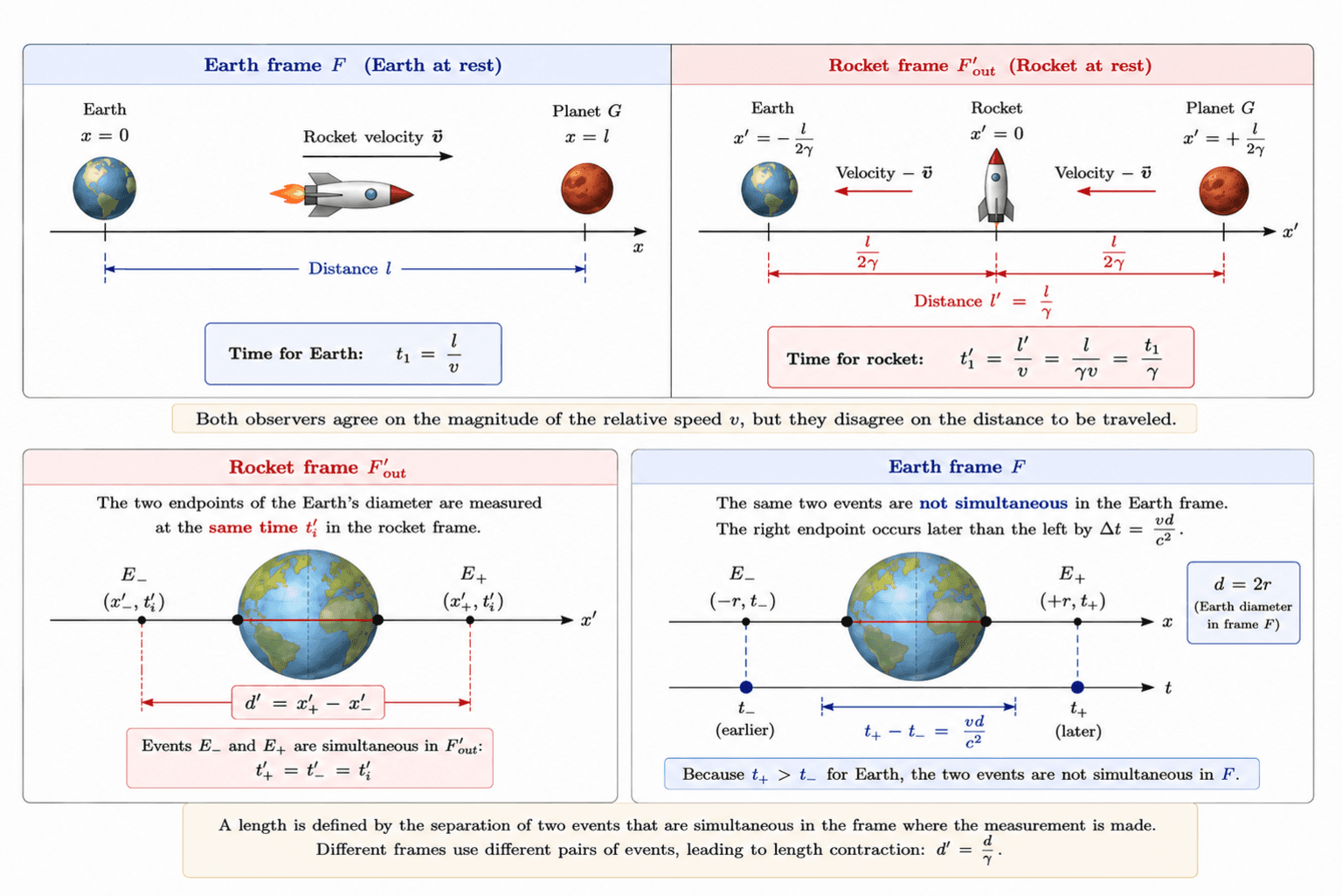
Outbound trip: Earth frame versus the outbound rocket frame .
As shown previously in reciprocal relative velocities , if the rocket moves with velocity relative to Earth, then Earth and planet move with velocity relative to the rocket. The magnitude of the relative velocity is therefore the same in both descriptions and is equal to . Consequently, according to the rocket twin, planet approaches him with speed , and the time required for the planet to reach him is
Eq:Outbound_time_rocket_length
This is identical to the result obtained directly from the Lorentz transformation in outbound time rocket lorentz . Since for , we also have
Thus, the two twins agree on the events marking the beginning and the end of this portion of the journey, but they assign different spatial distances and different elapsed times to it. For the twin on the rocket, the distance between Earth and planet is shorter, and correspondingly less time elapses before the rocket and the planet meet.
3. Trip Back to Earth
Once the twin on the rocket reaches planet , he reverses his motion and begins the journey back to Earth. As in the initial acceleration phase, we assume that the time required to reverse the motion is very small compared with the duration of the journey, and we neglect both this time interval and the corresponding displacement.
We denote by the event at which the traveling twin reunites with the twin on Earth. For the return cruise, let denote the inertial frame comoving with the rocket. The rocket moves with velocity relative to the Earth frame , while Earth and planet move with velocity relative to . The magnitude of the relative velocity is therefore again . Moreover, for the same reason discussed in the previous section, the distance between Earth and planet measured in the inbound rocket frame is
Consequently, the elapsed time measured by the twin on the rocket during the return journey is
Eq:Return_time_rocket
For the twin on Earth, on the other hand, the rocket travels the distance from planet back to Earth with speed . The elapsed time for the return journey is therefore
Eq:Return_time_earth
The outbound and return portions of the journey have the same duration in each corresponding description,
Within the approximation that the launch and turnaround durations and displacements are negligible compared with the two cruise portions, the total elapsed time measured by the clock carried by the rocket is therefore
Eq:Total_journey_time_rocket
whereas the total elapsed time measured by the clock on Earth is
Eq:Total_journey_time_earth
Since for any nonzero relative velocity,
Eq:Twin_elapsed_time_difference
Thus, at the reunion event on Earth, the clock carried by the traveling twin records a smaller elapsed time than the clock that remained on Earth. Since each twin's clock measures the time experienced by that twin, the traveling twin is younger when the two are reunited. The quantity is the elapsed time recorded by the same continuous onboard clock throughout the entire journey; it is not a coordinate time belonging to one global inertial frame . The complete journey is summarized in the following figure. The upper row represents the motion in the Earth frame, while the lower row represents the corresponding description during the constant-velocity portions of the rocket's motion. The short turnaround interval is shown explicitly but is assumed to be negligible compared with the duration of the two cruise portions.
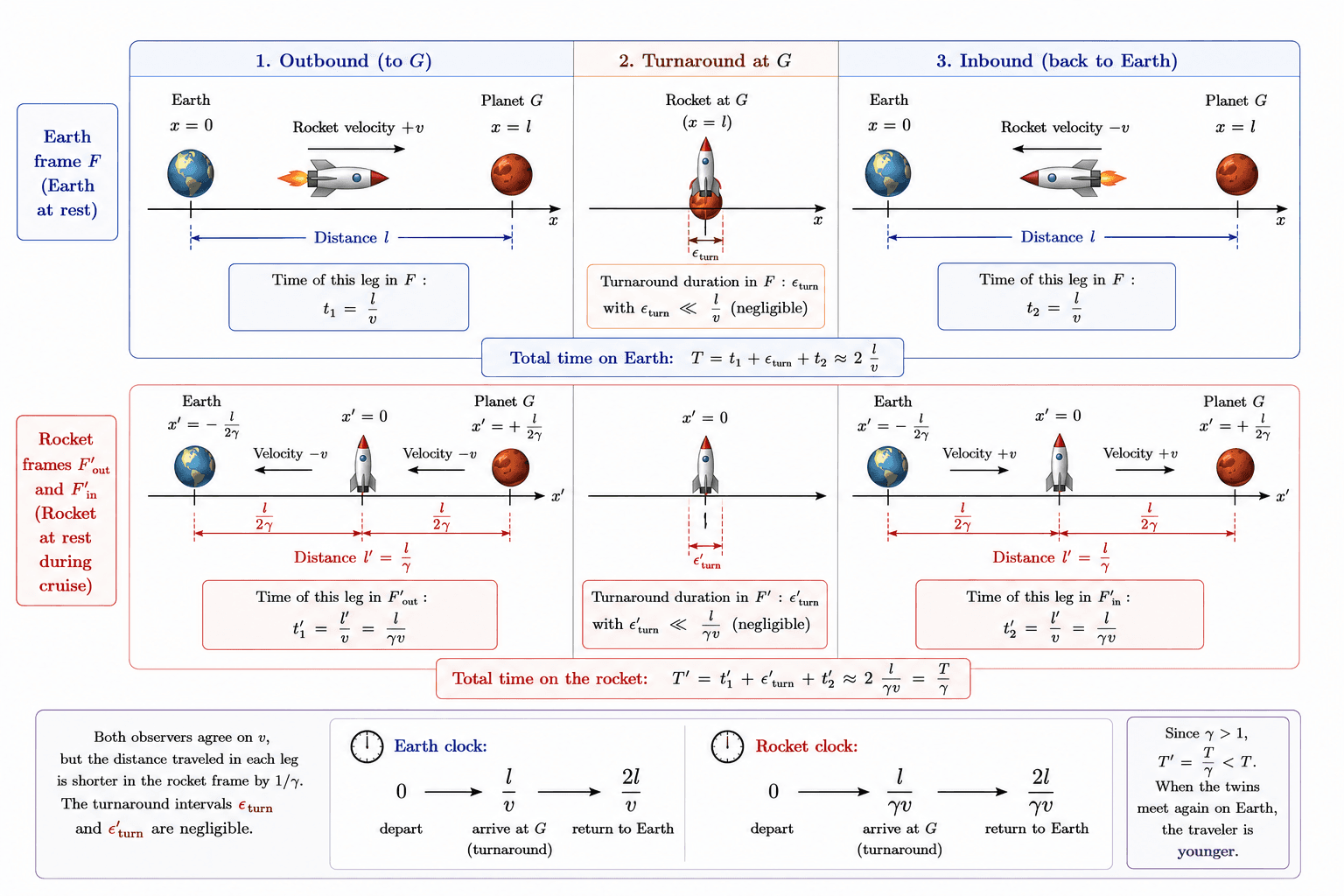
Complete journey in the Earth frame and in the corresponding outbound and inbound rocket frames and .
As in the previous figure, the precise positions shown during the cruise are schematic. What is physically relevant is that Earth and planet are separated by the distance in the Earth frame and by the contracted distance in the corresponding outbound or inbound rocket frame.
4. Events and the Apparent Asymmetry of Time Dilation
We will now return to the question raised at the beginning of the essay and address the apparent asymmetry in the motion of the two twins. One of the apparent contradictions comes from the familiar statement that a clock observed from a reference frame in which it is moving appears to run more slowly. It therefore seems reasonable that, when the rocket reaches planet , the clock carried by the rocket has recorded less time than the clock on Earth. By symmetry, however, we might also expect the twin on the rocket to find that the clock on Earth has recorded less time than his own.
The resolution of this apparent contradiction requires us to be very precise about the events being compared. The familiar formulas for time dilation do not apply to arbitrary events: they apply to particular pairs of events selected by specific conditions.
Let us first consider the arrival of the rocket at planet from the point of view of the twin on Earth. The arrival event is
At the same time in the Earth frame, the twin on Earth is still at the origin of . We therefore consider the event
Thus, in the Earth frame, the two events
are simultaneous. The first occurs at planet , while the second occurs at the position of the twin on Earth. In this description, the Earth twin is at rest and his position remains fixed at .
Let us now describe the same arrival event from the outbound rocket frame . Its coordinates are
At this same time in , the twin on Earth is not at a fixed spatial position. He is moving toward the negative direction with velocity . Since the distance between Earth and planet measured in the rocket frame is
at the instant at which the rocket reaches planet , the Earth twin is located at
We therefore introduce the event
Thus, in the rocket frame, the two events
are simultaneous. Again, one event is the arrival of the rocket at planet , while the other occurs at the position of the twin on Earth at that same time according to the rocket frame. The difference is that, in this description, the Earth twin is moving rather than remaining at a fixed spatial coordinate.
We can now determine how the event is recorded in the Earth frame by using the inverse Lorentz transformation,
For the spatial coordinate we obtain
as expected, since is the position of the twin on Earth. For the time coordinate,
Since the elapsed time measured by the rocket clock between departure and is
we may equivalently write
We therefore recover the familiar reciprocal time-dilation result: according to the outbound rocket frame, the clock on Earth has advanced by less than the clock carried by the rocket.
There is nevertheless no contradiction with the result obtained previously. The Earth event used in the Earth-frame description and the Earth event used in the rocket-frame description are not the same event. Indeed,
Thus,
The two events are selected by different simultaneity conditions. In the Earth frame,
while in the outbound rocket frame,
The two reference frames therefore associate different events on the Earth twin's reference system with the same arrival event .
This distinction is the key point. The arrival event is not arbitrary: it is constrained by the physical setup of the experiment. Planet remains at the fixed position in the Earth frame, while the rocket travels with speed . Therefore the rocket can meet planet only when
which fixes the Earth-frame time of the arrival event to be
The event selected by the reciprocal time-dilation comparison in is instead , a different event on the Earth reference system. The two apparently contradictory statements therefore compare different pairs of events.
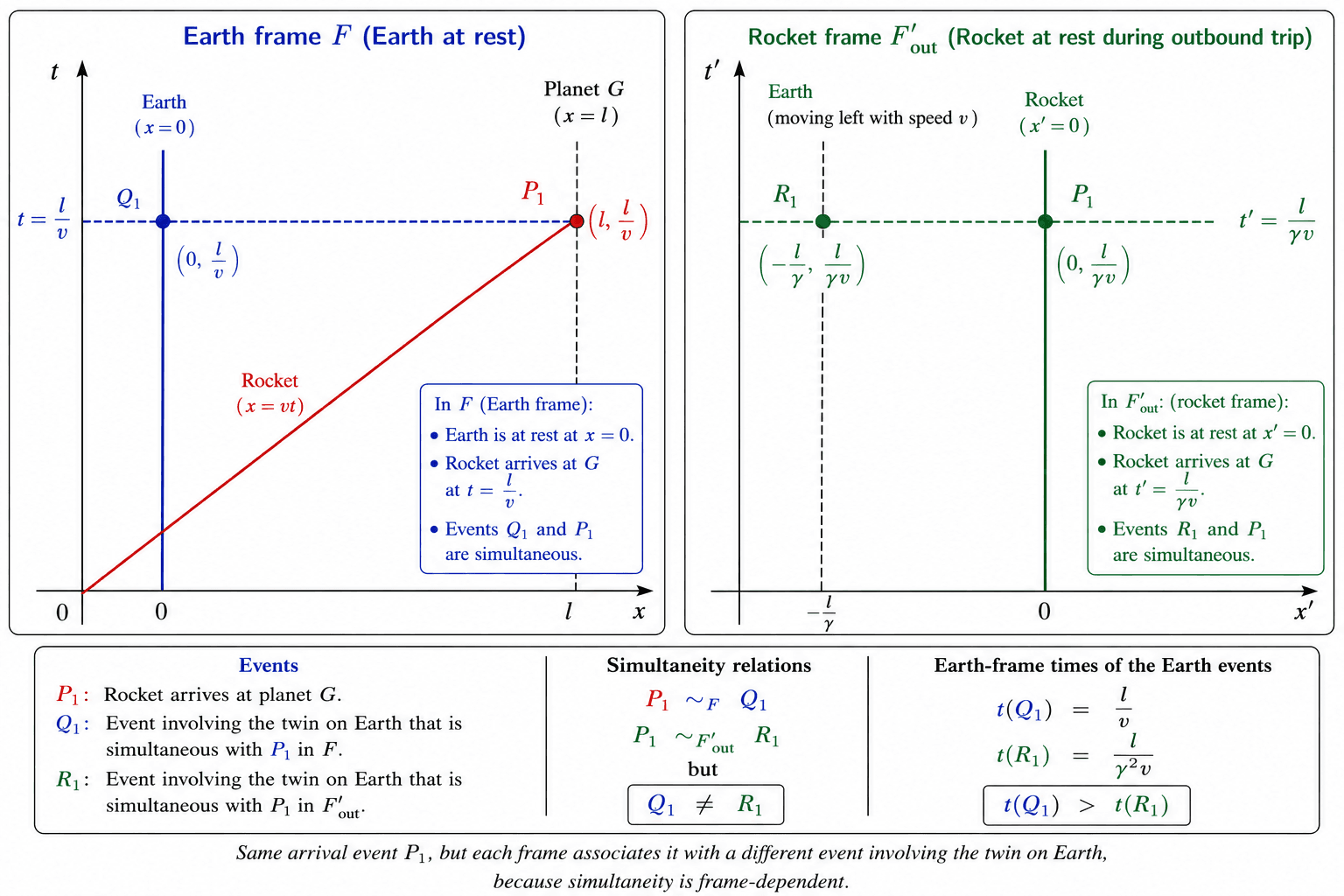
The role of events in the comparison of elapsed times.
This illustrates a principle that is fundamental throughout special relativity: before applying a formula for time dilation, length contraction, or simultaneity, we must first identify precisely the events to which that formula refers.