Colophon
How Bach and Physics is written, typeset, and built.
Motivation
Bach and Physics was designed with two principal goals. First, the author wanted contributors to be able to write and publish technical essays without requiring knowledge of web development. An author should be able to work almost entirely in LaTeX, using the same tools and document structures that would be used to prepare a conventional scientific or mathematical document.
Second, the site was designed to be as lightweight and responsive as possible. Since LaTeX essays are essentially static documents, there is little reason to parse and construct them in the reader's browser. A custom LaTeX-to-React compiler was therefore developed to process the documents ahead of time and generate the React representation used to produce the final static pages. Only the small number of components that require interaction are hydrated in the browser.
The Role of AI
Artificial intelligence is profoundly transforming the way we work, and it has played an important role in making the rapid development of Bach and Physics possible. It will undoubtedly continue to do so. At the same time, clear boundaries have been maintained between the work of the author and the role of AI throughout the project.
Scientific Content
The physics and mathematics presented in the essays are the work of the author. AI is not used to generate the scientific content or to determine the mathematical and physical arguments developed in the essays.
AI has, however, proved to be an invaluable sparring partner during their preparation. It has been used to challenge derivations, identify possible mistakes, discuss the structure and presentation of arguments, and help maintain the standards of detail and clarity that the project aims to achieve. It has also assisted with mechanical tasks such as converting handwritten notes and screenshots into LaTeX.
Software
The software architecture of Bach and Physics was designed by the author and was not created through “vibe coding.” The principal React components, the LaTeX-to-React publishing system, and the supporting packages and abstractions were designed and developed as a coherent software architecture rather than generated from high-level prompts.
Among the systems developed for the project are a general-purpose LaTeX-to-React publishing system using Ohm for parsing and KaTeX for mathematical typesetting, reusable React building blocks, and a flexible layout system based on CSS Grid.
AI has nevertheless been an extremely effective development partner. It has helped evaluate architectural choices, identify and diagnose bugs, develop test suites, work through the intricacies of the Ohm grammar, and resolve package-management, build, and deployment problems.
AI has also contributed more directly to routine development tasks, including refactoring, writing configuration files, implementing well-defined changes, and handling repetitive or mechanical aspects of the implementation. These contributions have substantially accelerated development without replacing the author's responsibility for the architecture and the critical components of the system.
Figures, Design, and Language
AI has played a more direct role in other aspects of the project. Most of the original illustrations and figures used throughout the site have been created with the assistance of generative AI. AI has also contributed substantially to the visual development of the site by providing suggestions on layout and presentation.
Finally, AI has been used extensively as an editorial tool. The ideas and original prose are those of the author, but AI has helped revise the English, improve clarity and fluency, and express the author's intended meaning more effectively.
Without AI, Bach and Physics could certainly have been built, but bringing the project to its present state would have taken considerably longer.
Writing
All essays in Bach and Physics are written in LaTeX. The web pages are generated directly from the LaTeX source files. This allows the author to write a single LaTeX document, relying on most of the standard LaTeX environments, without having to create or maintain a separate version for the web.
The Publishing System
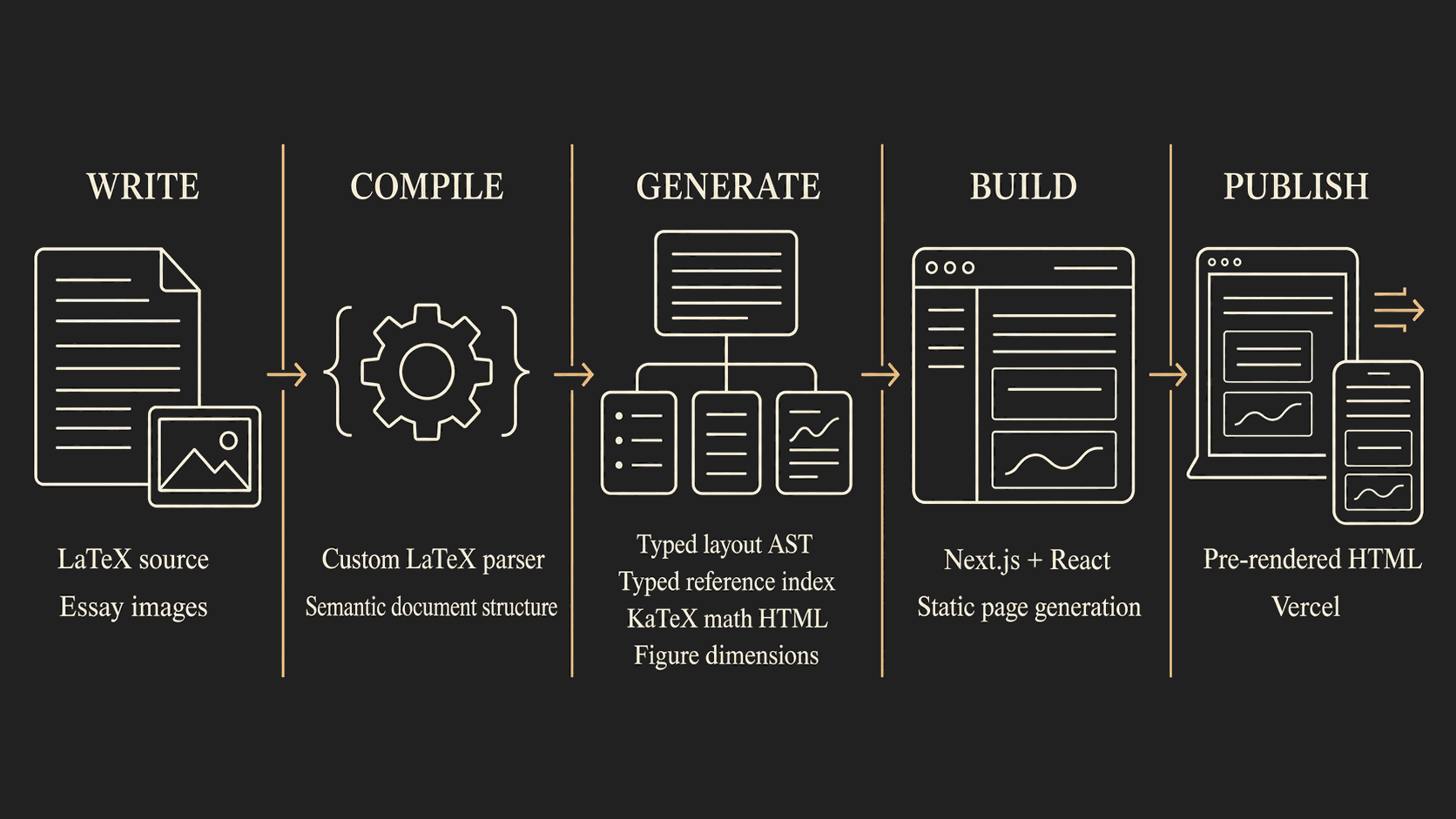
Bach and Physics uses a custom publishing system developed specifically for the site by the author. The LaTeX source is parsed with Ohm, using a custom grammar that converts the supported document structures into a semantic abstract syntax tree (AST), which is then transformed into React components for publication on the web.
The system supports the LaTeX structures used throughout the essays, including sections, mathematical environments, equations, figures, cross-references, and citations, while preserving the organization of the original document.
Typesetting and Rendering
Mathematical expressions are typeset using KaTeX as part of the page generation process. KaTeX is particularly well suited to this project because it can run in a Node.js environment, allowing the mathematical expressions to be converted to HTML during the build rather than in the reader's browser.
The LaTeX documents are compiled once and the resulting pages are rendered to static HTML during the build, so that no document parsing or generation is required in the reader's browser. Limited React hydration is used only for the few interactive components, such as equation references and figure zooming.
This approach keeps the client-side application lightweight and allows even mathematics-heavy essays to load and render quickly.
The Website
The website is built with Next.js, React, TypeScript, and Material UI. The publishing system is organized as a collection of independently versioned packages, which together provide the infrastructure used by Bach and Physics to process and publish its essays.
The production site is deployed on Vercel, where the complete collection of essays is built from its LaTeX sources and published as optimized static web pages.
Typography and Design
The design of Bach and Physics is intentionally restrained, with an emphasis on typography, readability, and the presentation of mathematical content. The layout is designed to preserve the character of a technical document while taking advantage of the navigation and presentation possibilities of the web.
Images and historical material
Historical manuscripts, portraits, diagrams, and other visual source material are identified on the pages where they appear. Original figures are prepared specifically for the essays unless otherwise noted. All externally sourced images and historical material used on the site are in the public domain.
Corrections and Revisions
The essays are living documents and may be revised as explanations are improved, notation is clarified, or errors are discovered. Corrections and comments are always welcome.