
Special Relativity
Lorentz Transformations
The transformation of time and space between inertial reference frames for a boost in an arbitrary direction.
This essay follows Einstein's clock-synchronization argument and develops the Lorentz transformation for a general velocity boost. It makes explicit the geometry parallel and perpendicular to the boost and derives the corresponding transformations of space and time.
Prerequisites
- Linear algebra and inner-product spaces
- Multivariable calculus
- Fundamental principles of special relativity
Contents
I. Introduction
The Lorentz transformation is one of the cornerstones of modern physics. It relates the measurements of space and time performed by different inertial observers and underlies virtually every aspect of Special Relativity. Because of its fundamental importance, it is often introduced early and presented directly in matrix form. While this approach is efficient, it can leave the reader with little physical intuition as to why the transformation has the form it does or what it actually means.
In this section we revisit Einstein's original derivation, extending it from the special case of motion along a coordinate axis to an arbitrary boost direction. Rather than starting from the final matrix, we derive the Lorentz transformation from simple physical assumptions, making explicit every step of the argument. Along the way, we will emphasize an important conceptual point that is often left implicit: the Lorentz transformation does not determine what different observers measure, but rather relates the independent measurements performed in different inertial reference frames.
Einstein original derivation considered the special case in which the relative velocity is aligned with the x-axis, so that directions perpendicular to the motion remain unchanged by construction. In this section, we follow Einstein's reasoning and extend the derivation to an arbitrary boost direction. Our goals are as follows:
- 1.General Boost Transformation:
- •We derive the Lorentz transformation for a general boost, where the relative velocity is represented by an arbitrary vector.
- •This broader approach allows us to handle boosts in any direction, not just along the -axis.
- 2.Transverse Length Invariance:
- •We explicitly discuss the conditions that ensure the preservation of lengths perpendicular to the velocity direction.
- •This consideration is crucial for maintaining consistency across reference frames.
- 3.Time Transformation via Clock Synchronization:
- •Following Einstein's original method, we will derive the transformation of time based on clock synchronization.
- •This step lays the foundation for our subsequent analysis.
- 4.Lorentz Transformation for Time and Space:
- •Using the invariance of the speed of light, we obtain compact expressions for the transformations of both space and time.
Assumptions and Prerequisites: We assume that readers are familiar with advanced calculus, linear algebra, and the fundamental principles of Special Relativity.
Notation . We use Dirac's bra-ket notation as a compact language for vectors, dual vectors, and linear operators. Despite its widespread association with quantum mechanics, the notation is purely linear-algebraic and is equally applicable to Euclidean and spacetime vector spaces. Readers unfamiliar with the notation may consult any standard reference; for a concise introduction, see the Wikipedia article on bra-ket notation. https://en.wikipedia.org/wiki/Bra\%E2\%80\%93ket_notation .
Although the Lorentz transformation is often presented directly in matrix form, deriving it from Einstein's original arguments provides valuable physical insight into the geometric structure of spacetime and, perhaps more importantly, into the operational meaning of the transformation itself. Once this viewpoint is established, many of the central ideas of Special Relativity, including proper time, four-vectors, and relativistic dynamics, follow more easily.
II. Synchronization of Clocks
In Special Relativity, the concept of clock synchronization plays a fundamental role in developing the Lorentz transformation of time and space. Although seemingly straightforward, this concept deserves careful discussion, as defining synchronization becomes essential for determining when events occur simultaneously. We begin with a simple thought experiment. Imagine two observers, A and B, both at rest within the same reference system but positioned at different locations. These observers, A and B, each have their own clocks, measuring time independently. Consider an experiment where a photon is emitted from A, travels to B, and gets reflected back to its origin in A. Observer A records the time of emission as , while observer B notes the time of reflection as . Finally, A marks the time of the photon arrival as . We assume that, after the experiment, the two observers compare the times recorded on their respective clocks (for example they would exchange data after the experiment). A possible outcome is shown in the table below (units of time are not relevant in this discussion):
Time in A | Time in B | Event |
|---|---|---|
1 | 2 | Emission, |
3 | 4 | Reflection, |
5 | 6 | Arrival, |
If the observer at point B used the time difference to compute the time needed for the photon to reach B, they would obtain an incorrect result of 3 instead of the actual value of 2. More worrisome, the time difference would be 1, falsely suggesting that the two observers are not at rest with respect to one another. These discrepancies occur because the two clocks are not synchronized. The way for B to synchronize their clock with A is to record the time stamp , wait for the photon to get back to A, ask A for , and set the clock in B such that:
Eq:Clock_synchronization
which is realized in this case by setting their clock back 1 unit. This requirement defines Einstein synchronization. Having established a procedure for synchronizing clocks within a single inertial frame, we can now investigate how space and time measurements compare between two inertial frames in relative motion. This leads directly to the Lorentz transformation. This is the subject of the next sections.
III. Transformation of Time
In this section we will derive the equation for the transformation of time between two systems of reference moving with constant relative velocity.
1. The Mirror Experiment
We now examine the mirror experiment from the perspective of a new reference frame. In this scenario, the mirror and the emitting source are both at rest within a system of reference , which itself is in motion relative to another system of reference . Observers in assign to each event a time and a position , while observers in assign the corresponding quantities and . We choose the origins of the two reference frames to coincide at .
Experiment Observed from
The source is located at the origin of and the mirror is positioned at a fixed location in an arbitrary direction from the source. A photon is emitted at a time ; it reaches the mirror at time where it is reflected, and it arrives back at the source at time .
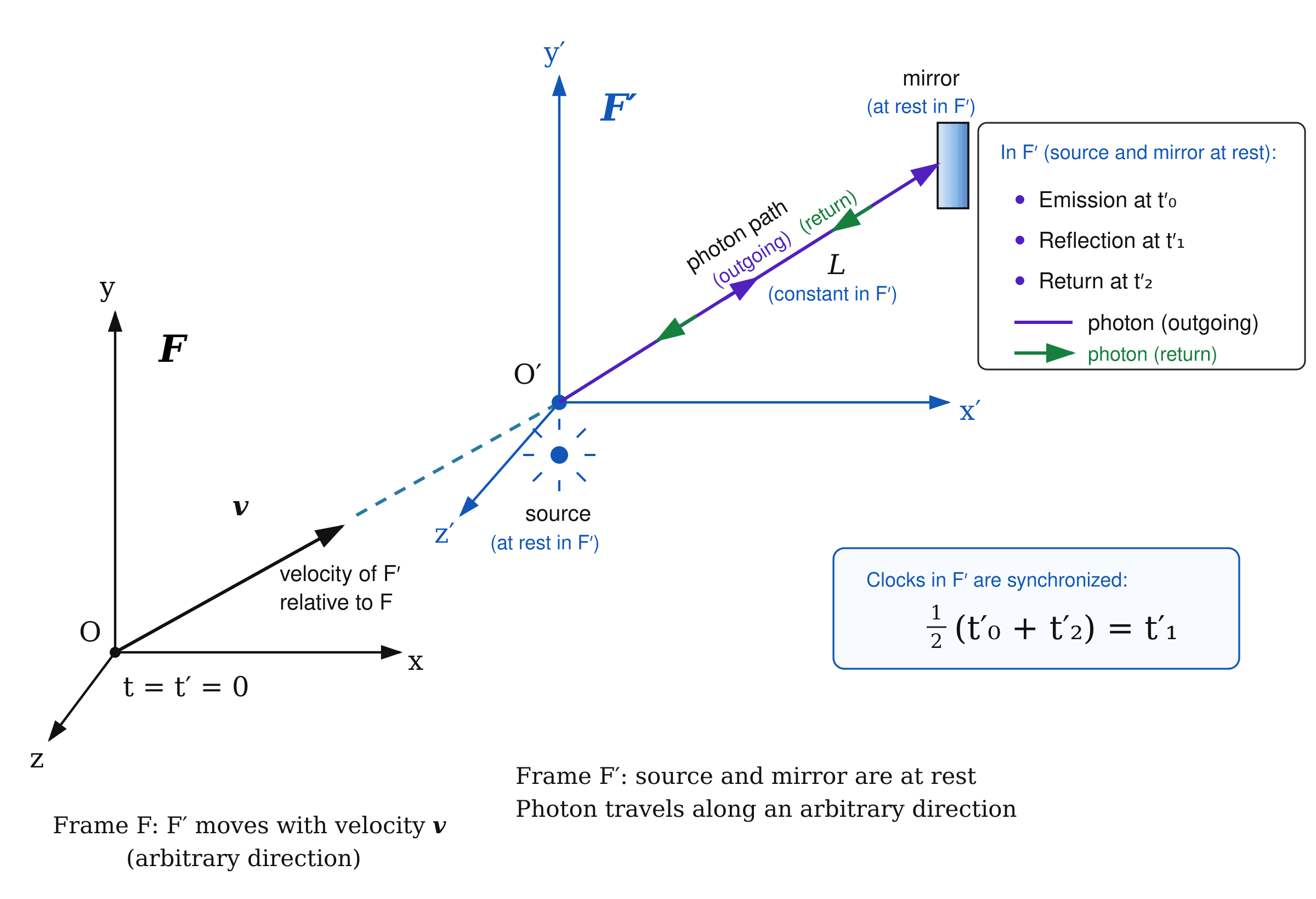
Figure 1: Mirror experiment viewed in the reference frame . The source and mirror are at rest, while the photon propagates along an arbitrary direction.
As we assume that the clocks in are synchronized, the following relation holds true:
Eq:Clock_synchronization_moving
Experiment Observed from
Now we examine the three events---emission, reflection, and arrival back at the source--- from the viewpoint of reference frame . It is crucial to emphasize that all time, velocity, and distance quantities in this section are assumed to be measured within the system of
reference . The photon is emitted from the source at time and at the position where is the velocity of measured from .
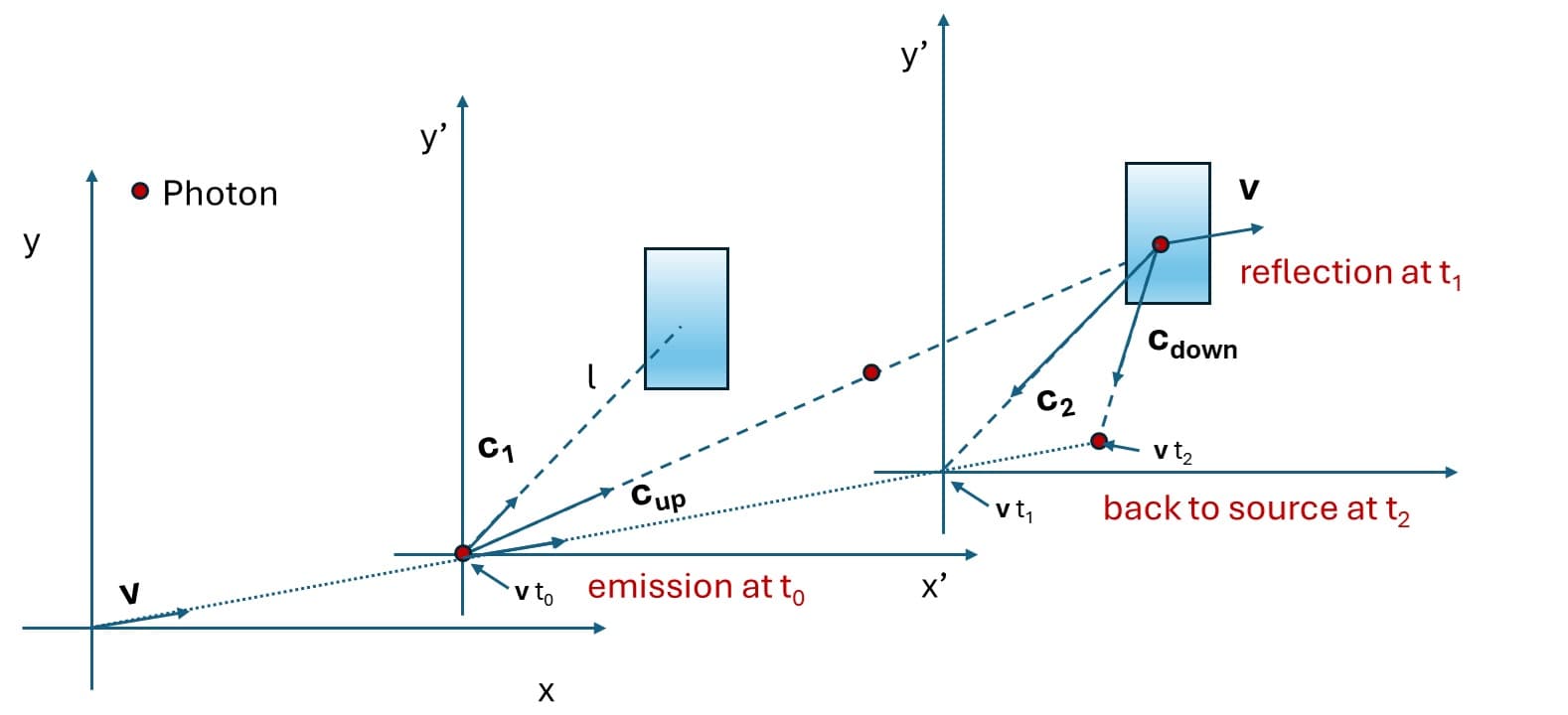
Figure 2: Velocities and positions of the photon seen from
The photon travels to the mirror with speed , and it reaches it at a time:
where is the distance between the source and the mirror measured simultaneously in at the time of emission. We assume that the source and mirror remain at a fixed distance from one another throughout the experiment. The vector denotes the photon velocity relative to the moving frame , expressed in the coordinates of . When the photon reaches the mirror, its position will be
The time when the photon reaches the source back again is
where is the photon velocity returning to the source.
The position of the photon when it meets the source is,
To derive the Lorentz transformation, we postulate the existence of a real-valued function on the events described in the reference frame ,
where are the coordinates assigned in to a given event. Formally, the events of emission, reflection and meeting the source again will be observed in as
Expanding the function
in a Taylor series around , we obtain
A similar expansion holds for :
Using the synchronization condition clock synchronization moving and taking the limit , we obtain
where
Assuming a linear relationship between the time in and the coordinates in as,
where is a vector transforming the spatial coordinates and is the coefficient transforming time, we arrive at the linear equation in and
Eq:Condition_on_p
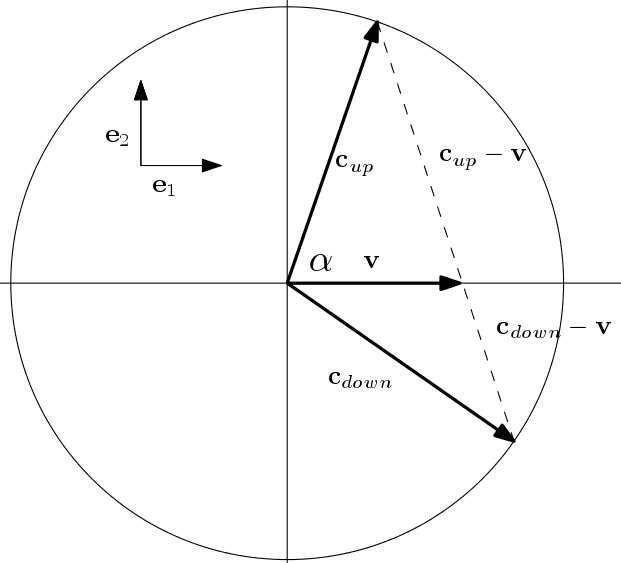
Fig. 3. Geometric construction relating the photon velocities and the boost velocity.
Equation condition on p can be further simplified by examining the directions of the vectors , , and . Since the photon in returns along the same line on which it traveled toward the mirror, the vectors and are collinear and oppositely directed, although their magnitudes need not be equal. Consequently, , , and all lie in the same plane, as shown in Fig.~3. In the system of reference of three mutually orthogonal unit vectors , , and , with and in the same plane of and , and in the same direction as , the vector has components,
and equation condition on p simplifies to
Since the direction of the photon is arbitrary, we choose in the direction of the component of orthogonal to . With this choice, lies in the plane spanned by and , and therefore . From
we arrive at
which has solutions
The transformation of time between and becomes then
Eq:Transformation_of_time
where depends only on the relative velocity between the two frames.
IV. Transformation of Space
1. The Most General Linear Transformation
The Lorentz transformation describes how the coordinates and the time of the same event observed in and are related to each other. We postulate that the transformation is linear,
where is a matrix depending only on the velocity vector , and is the four-vector
A four-vector can be expanded in the basis formed by the mutually orthogonal unit vectors , and , with chosen parallel to :
and the Lorentz transformation in its most general form becomes
Eq:General_Lorentz
where are, at this stage, arbitrary. The transformation of time transformation of time can be utilized to identify some of the but not all of them: additional physical assumptions are required on how events are observed in and to restrict the possible choices for .
2. Determining the Time Transformation
The transformation applied to a four-vector with only a time component gives,
From the previously derived transformation of time transformation of time , the image of a four-vector having only a temporal component contains only a component parallel to and a temporal component. Hence it cannot have components along or , and therefore
3. First Assumption: Preservation of the Longitudinal Direction
The first assumption we make is that the subspace spanned by the direction and the time direction is invariant. Thus, an event in with spatial components only along will not acquire components along or when observed in . Given an event , its transformation in will be,
Since this condition must hold for every value of , the coefficients of the basis vectors and must vanish. Hence,
The general form general Lorentz further simplifies as,
4. Second Assumption: Invariance Orthogonal to the Boost Direction
The second assumption needed is that the spatial components along and of any event preserve their direction and length under . For an event , the corresponding event in will be,
Our assumption therefore requires and , which results in a further simplification of :
Using the previously derived transformation of time , we identify
We therefore arrive at the final functional form of :
Eq:Simplified_Lorentz
Finally, the coefficients and must be positive to preserve the orientation of the longitudinal spatial axis and the direction of increasing time.
5. Third Assumption: Invariance of Light Speed
In Special Relativity the spacetime interval between two events and is defined as
and can be written in bi-linear form as
where and
A spacetime interval measured in is linked to the same interval in by the Lorentz transformation
In the system we consider a photon moving along a unit vector . The photon at time is in the position , and moves to the position at the time . Since the spacetime between the two events is identically zero,
When we examine two events occurring along the trajectory of a photon (referred to as the photon's world line), the spacetime interval in must also be zero, assuming that the speed of light remains invariant,
equivalent to,
Eq:Invariance_light_speed
for all such that . To solve the equation above, we need , which is with the time component's sign changed,
and is readily obtained by interchanging the bra and ket vectors,
The operator is
and the equation for the invariance of speed of light invariance light speed reads,
The above equation is identically zero for all such that only if,
which admits the following solution, continuously connected to the identity transformation at :
The Lorentz transformation takes the final form
Eq:Lorentz_transformation
The inverse of transforms coordinates from to . It is obtained by reversing the boost velocity and can be verified directly:
Eq:Lorentz_inverse
The Lorentz transformation written explicitly in terms of the velocity vector, using , reads,
Eq:Lorentz_in_velocity
When has the direction of the -axis, the transformation simplifies to the original Einstein formula:
Eq:Lorentz_1d
Finally, one readily verifies that the Lorentz transformation satisfies the condition , hence for every pair of events, not only for events lying on the worldline of a photon:
Eq:Spacetime_interval_invariance
V. A Final Remark on the Meaning of the Lorentz Transformation
When studying the Lorentz transformation, it is important to keep in mind a simple—perhaps obvious—but surprisingly often unstated point.
Each inertial reference frame possesses its own system of clocks and rulers. Observers at rest in the frame measure space and time using their own clocks and rulers, while observers at rest in perform the same measurements using their own independent instruments. The uniform motion of one frame relative to the other does not physically modify either system. This principle was already implicit in Galilean relativity and remains equally valid in Special Relativity.
Imagine that we remain on Earth, going about our everyday lives, while an alien spacecraft flies past us at a speed approaching that of light. Suppose that the alien civilization is familiar with our way of measuring time. Through previous encounters with humanity, they know what we mean by a second, a minute, an hour, and a day.
Nothing unusual would happen from our perspective when the aliens fly by. Our clocks would continue to tick at their normal rate, our rulers would retain their usual lengths, and the laws of physics would proceed exactly as they always have. To us, there is nothing remarkable about our relative motion with respect to the alien spacecraft. In fact, we would not even know that an alien spacecraft was observing our motion. We would wake up, go to work, build telescopes, and perform experiments exactly as we always have. Our clocks would continue to tick normally, our rulers would retain their usual lengths, and the space and time we measure would simply describe the universe in which we live.
The situation is exactly the same for the crew aboard the alien spacecraft. They, too, carry their own clocks and rulers, and from their perspective it is our planet that is rushing past at enormous speed. Their clocks tick normally, their rulers do not contract, and the physical world they experience is every bit as ordinary as ours. Each observer naturally believes that their own clocks and rulers describe the world correctly, and they are both right.
The alien observers, however, would describe our world very differently. They would conclude that one of our days lasts much longer than twenty-four hours, and that our cars, airplanes, and every object moving with the Earth are contracted along the direction of motion, as we shall derive in the following chapters.
What the alien observers can do is make sense of these apparently very long days by using the Lorentz transformation. Since they know the relative velocity between our two reference frames, they can compute how long our days actually last for us . They would then conclude that one day measured by our own clocks --- our proper time --- is exactly twenty-four hours, even though they measure a much longer time interval for the same process in their own reference frame. The Lorentz transformation therefore allows them to translate their description of our measurements into the measurements made by our own clocks and rulers.
It is important to appreciate the role of the Lorentz transformation in this process. The alien observers never directly measure the passage of time on our clocks. What they measure is the duration of one of our days according to their own clocks. Likewise, we never directly measure the passage of time on theirs. Every observer performs measurements using only the clocks and rulers belonging to their own reference frame. The purpose of the Lorentz transformation is therefore not to determine what an observer measures. Those measurements are obtained directly by experiment. Rather, its role is to reconcile the independent measurements performed in the two reference frames, allowing each observer to infer what the other observer measures using their own clocks and rulers.
Interestingly, if one of us were able to observe the alien spacecraft as it passed by, we would describe their world in exactly the same way. We would conclude that their days are much longer than ours and that distances along the direction of motion are contracted. Each observer therefore regards the other reference frame as exhibiting time dilation and length contraction, yet both descriptions are equally valid.
This is a profound departure from our own experience. Contrary to the Newtonian view, there exists no preferred or absolute frame of reference against which motion can be measured. There exists no hidden or absolute reference frame from which one could decide whether our description or that of the alien observers is the "correct" one.
The Lorentz transformation should therefore not be interpreted as imposing a relationship between the physical clocks or rulers belonging to the two reference frames. Rather, it provides the mathematical rule that relates the coordinates assigned by the two observers to the same spacetime event . The transformation does not constrain the independent evolution of time or space within either frame; it simply relates two different descriptions of one physical reality.
This distinction is essential. The Lorentz transformation is fundamentally a transformation between coordinate systems, not a law describing how clocks or rulers physically change because of motion. The phenomena of time dilation, length contraction, and the relativity of simultaneity arise only when comparing measurements of specific physical processes performed in different inertial frames through these coordinate transformations.
There is, however, one final viewpoint that deserves special attention. Besides the reference frames and , every physical object carries with it its own rest frame. This frame is not privileged in any universal sense, but it is privileged for the object itself: it is the frame in which the object remains at rest and in which its own clocks measure the passage of its history. The time measured by these clocks is called the proper time . Proper time is one of the fundamental quantities of Special Relativity and will become the natural parameter describing the history of every physical system throughout the chapters that follow.
It is worth emphasizing one final conceptual point.
Every observer performs measurements using only the clocks and rulers at rest in their own reference frame. The Lorentz transformation does not determine those measurements; they are obtained directly by experiment. Its purpose is to relate the independent measurements performed in different inertial reference frames.