
Classical Mechanics
Motion on the Rotating Earth
Applications of rotating-frame dynamics to motion near Earth's surface.
This essay applies the dynamics of rotating reference frames to motion near Earth's surface. Treating the Earth as a rotating frame, we derive the Coriolis and centrifugal contributions in terrestrial coordinates and examine how the general equations of rotating-frame dynamics acquire concrete physical meaning.
Prerequisites
- Dynamics in Rotating Reference Frames
- Vector calculus
- Introductory classical mechanics
Contents
- Earth-fixed reference frames
- Earth's angular velocity
- Local terrestrial coordinates
- Coriolis effects near Earth's surface
- Centrifugal effects near Earth's surface
- Latitude dependence
- Physical interpretation
Contents
I. Rotating-Frame Preliminaries
For a reference frame rotating with constant angular velocity , the acceleration measured in the rotating frame is
Earth:Acceleration Transformation
The corresponding inertial forces are therefore the centrifugal force,
Earth:Centrifugal Force General
and the Coriolis force,
Earth:Coriolis Force General
These expressions, derived in the previous essay, provide the rotating-frame dynamics used throughout the derivation of the Foucault pendulum.
II. Centrifugal and Coriolis Forces on Earth
In this section we study the centrifugal and Coriolis forces near the Earth's surface. To keep the analysis as transparent as possible, we model the Earth as a perfect sphere. Although this approximation neglects effects such as the Earth's oblateness, it captures the essential physics and provides a convenient setting for deriving the mathematical expressions used throughout this essay.
We consider a reference frame fixed to the Earth with origin at its center. The -axis points from the South Pole toward the North Pol to the North Pole, with positive direction from South to North. Earth's angular velocity is along the axis:
Earth:Angular Velocity
where is the angular velocity of the Earth equal to .
We will be interested in the motion of a body in the vicinity of the Earth surface, and the ideal coordinates to describe such a motion are the spherical coordinates , such that,
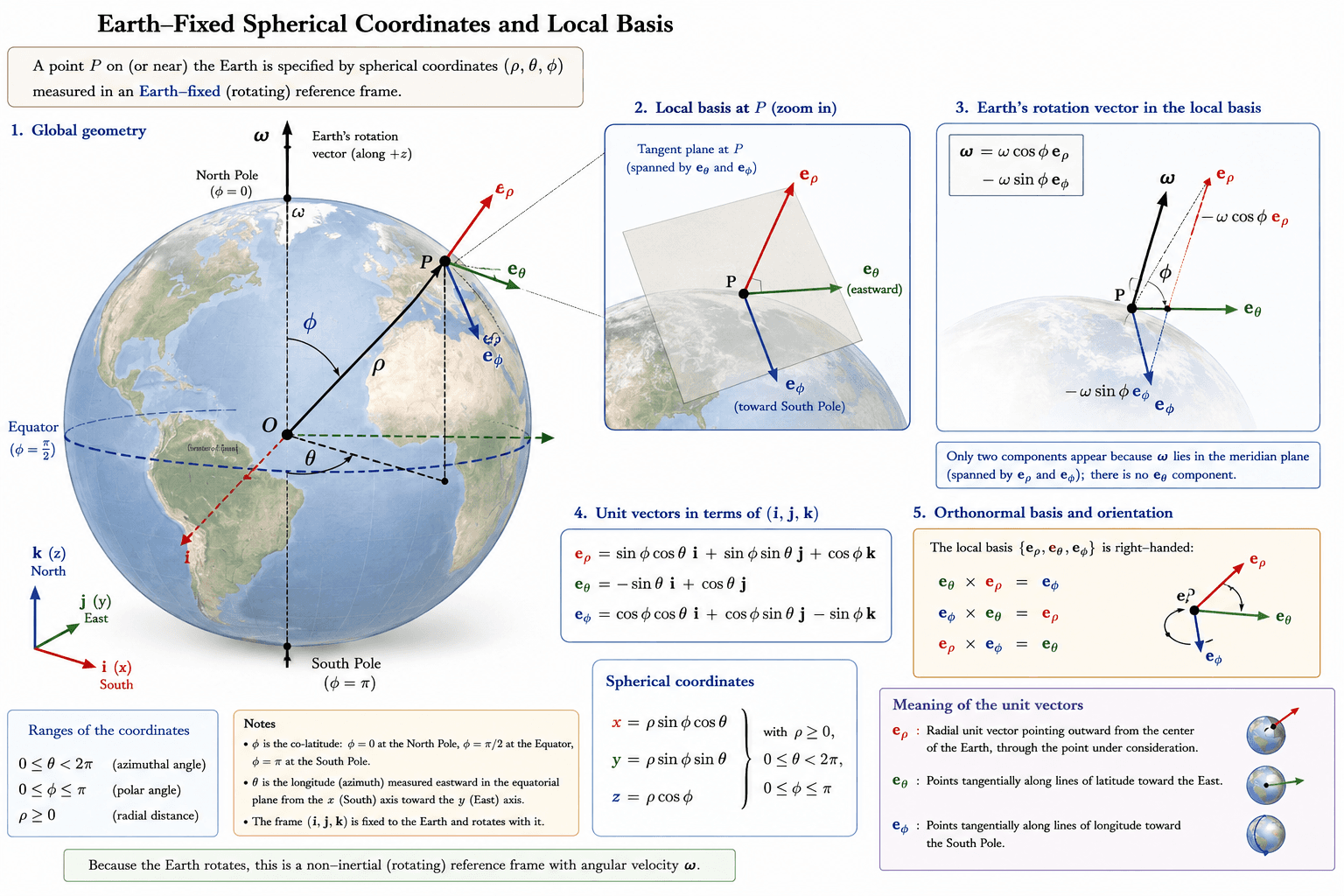
Earth-fixed spherical coordinates.
where is the radial distance from the center of the reference system, is the azimuthal angle, and is the polar angle. Associated with the spherical coordinates are the unit vectors , , and given by,
where , , and are the unit vectors of the rotating reference system along the , , and axes, respectively. The unit vectors define a local orthonormal basis and maintain the orientation of the reference system:
and they are related to the latitude and longitude of the Earth:
- •: Radial unit vector pointing outward from the center of the Earth, through the point under consideration.
- •: Points tangentially along lines of latitude towards the east.
- •: Points tangentially along lines of longitude towards the South Pole.
The position vector in spherical coordinates is,
and the angular velocity is represented by,
and finally the velocity of the body in spherical coordinates is given by,
Since the Earth's surface is naturally described by spherical coordinates, expressing both the angular velocity and the particle velocity in the local spherical basis considerably simplifies the derivation of the centrifugal and Coriolis forces.
1. Forces in Spherical Coordinates
In the rotating frame the body is subject to three forces: the gravitational force, the centrifugal force, and the Coriolis force.
- •The gravitational force is directed radially inward and is given by,where is the mass of the body and is the acceleration due to gravity.
- •The centrifugal force is directed radially outward from the axis of rotation and in spherical coordinates it is represented by the formula:Earth:Centrifugal Force Spherical
- •The Coriolis force is perpendicular to the velocity of the body and is quantified by the formula:which simplifies to,Earth:Coriolis Force Spherical
Before proceeding, it is instructive to examine the combined inertial force obtained by adding the centrifugal and Coriolis contributions,
One particularly interesting situation emerge from these expressions, which corresponds to a body at rest in the inertial frame. In such a situation the body at rest in the inertial frame appears in the rotating frame to move with angular velocity , while . Under these conditions, the combined inertial force is
The Coriolis force is therefore equal to twice the centrifugal force in magnitude and points in the opposite direction. Their resultant is an inward force equal to the negative of the centrifugal force. This resultant produces the centripetal acceleration observed in the rotating frame as the body appears to revolve around the Earth's axis with velocity .
2. Lagrangian in Spherical Coordinates
We now formulate the dynamics of the system in spherical coordinates. Under the assumption that the gravitational acceleration is constant and directed radially inward, the gravitational potential is
The centrifugal force derives from the position-dependent potential
The Coriolis force cannot be derived from an ordinary position-dependent potential. It can, however, be represented by the velocity-dependent generalized potential
Indeed, for each generalized coordinate , it satisfies
Explicitly,
Similarly, the centrifugal potential satisfies
The kinetic energy is
The Lagrangian is therefore
or, after combining the terms,
The appearance of the combination has a direct physical interpretation: it is the angular velocity of the body with respect to the inertial frame. The equations of motion follow from the Euler--Lagrange equations,
Since the Lagrangian does not depend explicitly on , this coordinate is cyclic and its conjugate momentum is conserved,
Expanding the Euler--Lagrange equations yields the nonlinear system
Earth:Spherical Equations Of Motion
3. Linearized Equations of Motion
We consider now the motion of an object covering distances over the Earth surface much smaller than Earth radius in any direction. We will assume the dynamics is in a neighbourhood of the position identified by spherical coordinates ,
where . Around this position a local system of reference can be constructed by the unit vectors , , and as,
and a point in the vicinity of the position has spherical coordinates and position,
which up to first order reads,
Under the assumption that , we have for the displacements in each direction,
We will therefore assume that the dynamics can be described by the perturbations,
where at all times , , and . The equations of motion spherical equations of motion can be expressed in terms of the displacements and simplified to first order as,
Earth:Linearized Spherical Equations
Defining dimensional variables of length as,
and defining a local coordinate system as,
the linearized equations of motion can be expressed as,
Earth:Local Cartesian Equations